
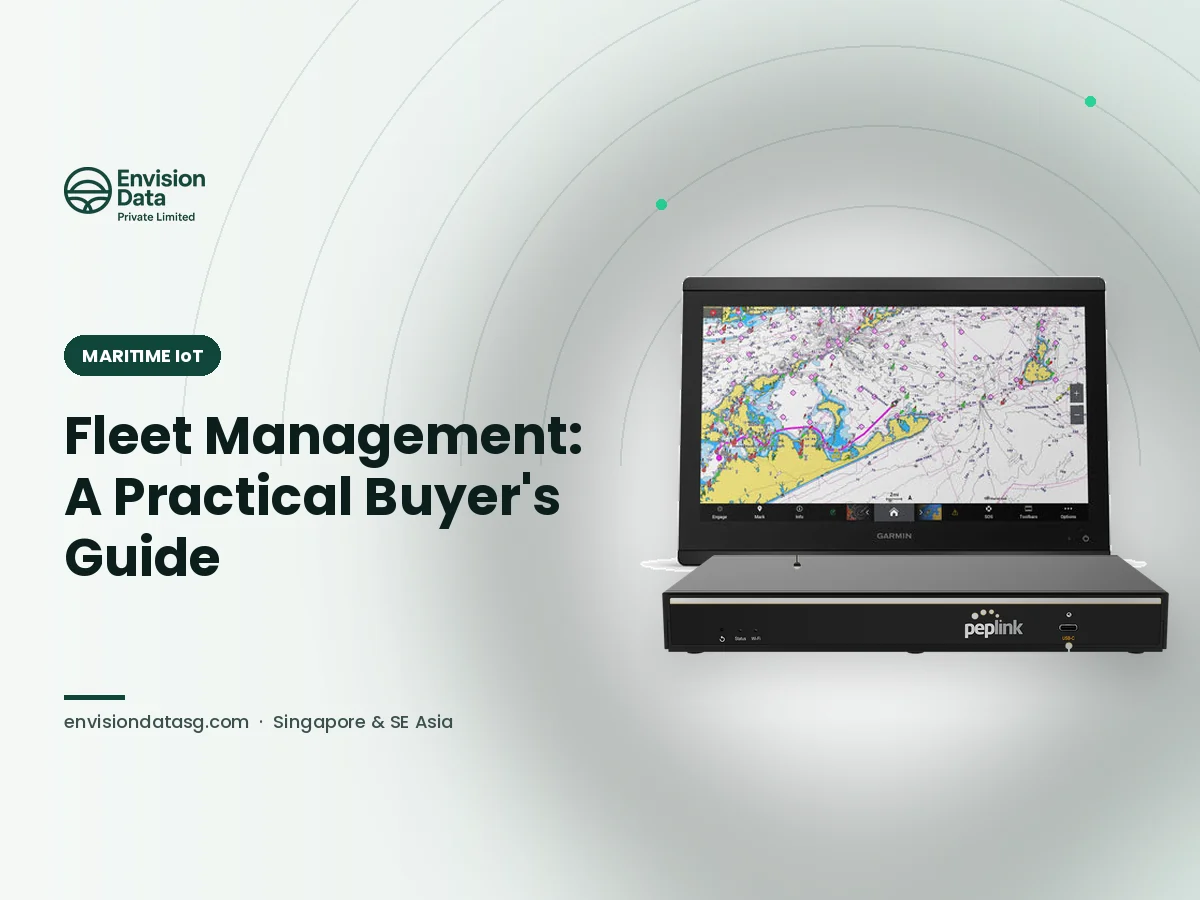
Maritime IoT used to mean a black-box GPS tracker bolted to a wheelhouse and a once-a-day position ping. In 2026 it means something far more useful: a complete data picture of every vessel in your fleet — where it is, what it is burning, how the engine is feeling, when the next service is due, and whether the crew is safe — streamed to a dashboard you can open on your phone.
This guide is the buyer’s view, not the engineer’s. It covers what is worth measuring, the hardware and connectivity that supports it, the SE Asian regulations driving fleet adoption, and how to start small.
What Maritime IoT Actually Is
Three layers, working together:
- Sensors and devices on the vessel — GPS, fuel meters, engine ECU taps, tank level sensors, cameras, AIS, panic buttons.
- Connectivity that moves the data ashore — Iridium SBD, Inmarsat IDP, 4G/5G cellular, Starlink, or a mix.
- A dashboard ashore where the data is stored, processed, alarmed on, and reported.
If any of the three is weak, the whole thing fails to deliver value. A great sensor with no connectivity is a logbook. A great dashboard with bad sensors is fiction.
What Is Worth Measuring
You do not measure everything. You measure the things that move money, safety, or compliance. For SE Asian fleets in 2026, the high-ROI list is short:
| Data category | What it answers | Why fleets pay for it |
|---|---|---|
| Position & voyage | Where is the vessel, ETA, speed, route adherence | Compliance, charterer reporting, theft recovery |
| Fuel consumption | Litres burned per hour, per voyage, per leg | Fuel is 30–60% of operating cost; even 3% savings pay for the system |
| Engine telematics | RPM, hours, oil pressure, exhaust temperature, alarms | Predictive maintenance, warranty evidence, downtime avoidance |
| Tank levels (fuel, fresh water, bilge) | How much is on board, leak detection | Bunkering accuracy, pollution prevention |
| Generator and power load | Genset run hours, electrical load profile | Maintenance scheduling, fuel optimisation |
| Crew safety | Man-overboard, panic button, rest hours | MLC compliance, insurance discount |
| CCTV and sensors | Bridge, engine room, cargo monitoring | Security, evidence, remote oversight |
Most fleets start with the first three rows — position, fuel, engine — because the ROI is fast and the procurement case writes itself.
Hardware: Sensors, Trackers, Gateways
- GPS tracker / vessel terminal: the core unit, with built-in modem(s) for satellite and/or cellular. Common brands include ORBCOMM, Queclink, Teltonika, Digital Yacht, Lars Thrane.
- Fuel flow meters: in-line meters on supply and return lines. Brands like KRAL, Aquametro, VAF Instruments. Critical to install correctly — bad installation gives bad numbers.
- Engine ECU integration: direct read of NMEA 2000 / J1939 / proprietary buses on modern engines (Cummins, Cat, MAN, Volvo Penta).
- Tank level sensors: ultrasonic or pressure-based, retrofit-friendly.
- Gateways and edge compute: small Linux boxes on board that buffer data, run rules locally, and only send the meaningful events ashore. This is what makes a satellite-connected vessel affordable.
Connectivity: How Data Gets Ashore
Choose the connectivity to match the data, not the other way round.
- Iridium SBD or Inmarsat IDP: low-bandwidth, low-cost, global. Best for position pings, alarms, periodic engine snapshots, panic buttons. Pennies per message. Reliable in any weather.
- 4G/5G cellular: excellent in port and within ~20 NM of shore in SE Asia. Cheap, fast, but goes dark offshore.
- Starlink Mini or Maritime: the new high-bandwidth path. Allows live video, large file uploads, fleet ERP integration, real-time engine streams.
- Smart routing: a good IoT gateway uses cellular when it can, satellite when it must, and rate-limits the satellite path to keep airtime bills predictable.
The Dashboard
The dashboard is where the IoT investment becomes visible to a non-engineer. It should answer four questions in under five seconds:
- Where is every vessel right now?
- What is each vessel doing — transit, fishing, idle, alarm?
- What is going wrong that I should care about today?
- What is the fuel and operating-cost trend this week vs last?
The dashboard should also generate the reports your charterers, regulators, and finance team already ask for — voyage logs, fuel reports, MLC rest-hour summaries, emissions data — so the team that hated the old paperwork now loves the new system.
Want a practical view of what your fleet really needs?
Share your fleet size and the problem you are trying to solve. We will suggest a sensible starting point, not a shopping list.
Regulatory Drivers in SE Asia
Compliance is the fastest-growing reason fleets adopt IoT. Three regional examples:
- Indonesia (KKP / Kementerian Kelautan dan Perikanan): Vessel Monitoring System (VMS) is mandatory for licensed fishing vessels above defined sizes; tracker certification and reporting are enforced.
- The Philippines (BFAR): e-registry and vessel-tracking obligations expand each year, especially for vessels above 3 GT operating commercial fishing.
- Malaysia (LKIM, MMEA): tracking and reporting requirements for licensed vessels, with progressive enforcement on tonnage thresholds.
For Singapore-flagged commercial vessels, IMO regulations on data, EEXI/CII reporting, and crew rest-hour compliance increasingly require the same kind of underlying telemetry that a good IoT system already collects.
What It Costs and What It Saves
Pricing is project-specific, but a representative SE Asian fleet pilot looks like:
- Hardware per vessel: a one-time fit-out covering tracker, fuel meter, gateway, and a few sensors. Often financed over 24 months.
- Connectivity per vessel: a small monthly satellite plan (e.g. Iridium SBD) plus an existing Starlink or cellular path the vessel already has.
- Dashboard / SaaS per vessel: a per-vessel monthly subscription tier from light tracking to full fleet management.
The savings, conservatively measured, come from fuel optimisation (typically 3–7% on a well-run pilot), reduced unplanned downtime through predictive maintenance, lower insurance premiums on tracked fleets, and avoided regulatory fines. Most pilots hit payback inside 12 months.
For a same-day SGD quote on a 1–5 vessel pilot, email sales@envisiondatasg.com or WhatsApp +65 9088 4899 with the vessel type, engine make, and what you want to measure first.
How to Start Without Committing the Whole Fleet
- Pick one or two vessels as the pilot, ideally with different duty cycles — say one fishing vessel and one tug.
- Start with three data categories: position, fuel, engine. Add the rest only after these are working.
- Run for 90 days and compare the dashboard data to the operations team’s perception. The conversations that follow are usually the most valuable part of the pilot.
- Roll out the fleet only after the pilot has at least one quantified saving the finance team accepts.
Related Reading
- VMS Indonesia: What Fishing Vessel Owners Need to Know in 2026
- Crew Welfare Internet at Sea: What Actually Works in 2026
- Starlink Maritime in Singapore: Plans, Pricing, and How to Buy
- GMDSS Equipment Singapore: What MPA-Flagged Vessels Actually Need
How Envision Data Helps
Envision Data designs and supplies maritime IoT and fleet management for SE Asian operators — hardware selection, install, satellite and cellular connectivity, dashboard onboarding, and ongoing support. We can scope a 1–5 vessel pilot, deliver a same-day SGD quote, and run the install in Singapore with regional install support across SE Asia.
Get a fleet IoT quote: email sales@envisiondatasg.com or WhatsApp +65 9088 4899. Tell us your fleet size, operating area, and the first two or three things you want to measure, and we will reply the same day.
How we can help
Fleet technology only pays back when it is sized to the job and set up properly. We help operators pick the right systems, install them and keep them working.
- Free fleet systems assessment
- Onboard network, Wi-Fi and cybersecurity design
- Fuel monitoring and fleet IoT with shore dashboards
- Pilot projects on one to five vessels before full roll-out
What happens when you contact us
- Short call or meeting — we listen to how your vessels operate.
- Vessel and route review — we check equipment, space, power, contracts and licensing.
- Clear recommendation — a written proposal and SGD quote, with options.
- Install and support — commissioning, testing and ongoing support.
Related: Fleet Manager bundle
Book a free fleet systems assessment
There is no obligation. If your current set-up is already the right one, we will tell you.
About the author
Steve leads Envisiondata Pte Ltd in Singapore. He has more than 20 years in cables, telecom infrastructure and satellite communications across ASEAN. He designs and supports connectivity for tugs, OSVs, harbour craft and commercial fleets across the region.

Written by envisiondataadmin
Leave a Reply