
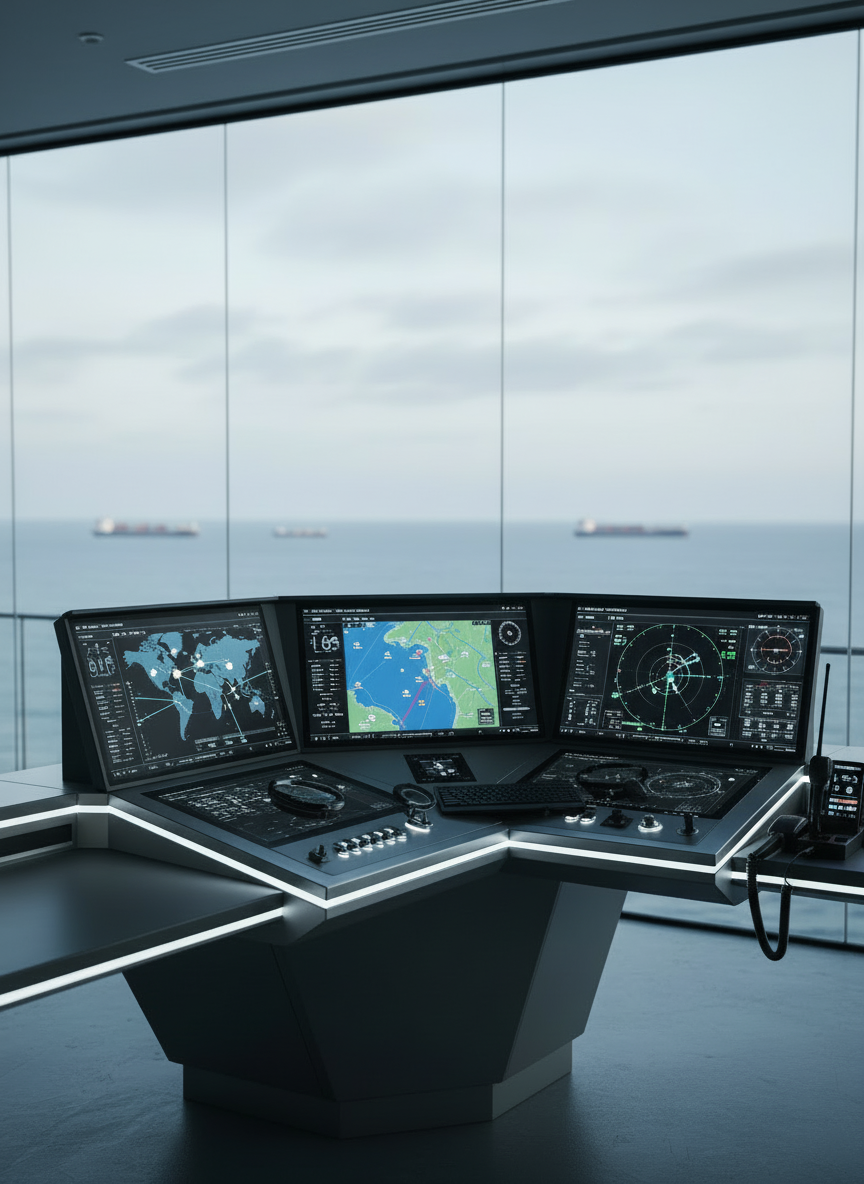
The antenna is the least-glamorous but most-consequential part of any maritime comms system. A well-chosen antenna doubles your effective range; a badly-chosen one turns a SGD 5,000 satellite terminal into an SGD 5,000 paperweight. This guide covers what to buy for VHF, VSAT, LEO (Starlink and OneWeb), and GPS on a Singapore-flagged vessel — and what to avoid.
The four antenna types every vessel needs
- VHF antenna — for marine radio (voice + DSC + AIS receive). Standard on every SOLAS-compliant vessel.
- GPS/GNSS antenna — for position fixing (ECDIS, AIS transmit, chart plotters). Often built into other equipment but a dedicated external one is more reliable.
- Satellite broadband antenna — VSAT dome (if legacy), Starlink flat panel, OneWeb flat panel, or bonded stack of two.
- 4G/5G cellular antenna — for coastal connectivity. Outdoor marine-grade antenna gives 3-5x more range than router internal antennas.
VHF antenna — the underrated fundamental
Every vessel over 6m needs a fixed VHF antenna. Range depends almost entirely on antenna height and cable quality.
| Antenna type | Height typical | Range typical | Cost (SGD) |
|---|---|---|---|
| Rubber duck (short whip) | 1m | 3-5 NM | 60-120 |
| Fibreglass 1.5m whip | Bimini/mast mount | 10-15 NM | 150-280 |
| Fibreglass 2.4m whip | Mast top | 20-30 NM | 280-450 |
| Fibreglass 6m whip (commercial) | Mast top, big vessels | 40-50+ NM | 500-900 |
Cable matters as much as antenna length — use RG-8 or better. Every 10m of cheap RG-58 costs you 1-2 NM of effective range.
GPS/GNSS antenna
Most vessels use the GPS built into their AIS or chart plotter. Fine for basic navigation. But if you rely on ECDIS as primary means of navigation (SOLAS vessels must), MPA requires a dedicated GNSS antenna with power supply and cable to ECDIS.
Best practice: install a dedicated multi-frequency GNSS antenna (Furuno GN-88, Kongsberg Seatex) with clear sky view. Cost SGD 400-1,200. Multi-frequency (L1+L5) gives better accuracy in urban port canyons where satellite reception is weak.
Satellite broadband — VSAT vs Starlink vs OneWeb antennas
| Antenna type | Physical size | Install complexity | Speeds | Cost (SGD) |
|---|---|---|---|---|
| VSAT Ku-band 1m dome | 1m diameter, tall dome | High — crane, radome, cabling | 4-10 Mbps | 45,000-80,000 |
| Starlink Maritime flat HP | ~57cm x 51cm flat | Low — bracket mount, one afternoon | 50-220 Mbps | 4,500-5,500 |
| OneWeb Intellian OW70M flat | ~76cm diameter flat | Low — bracket mount, one afternoon | 50-200 Mbps | 3,500-4,500 |
| Starlink Mini | ~30cm x 25cm pizza-box | Very low — clip on, 30 mins | 50-100 Mbps | 750-900 |
For any new vessel install, VSAT is essentially obsolete against the flat-panel LEO alternatives. Same or better performance, one-tenth the hardware cost, no crane required.
Unsure whether your vessel will pass its next radio survey?
Tell us your vessel type and trading area. We will list what you need, what you already have, and what is missing.
4G/5G cellular antenna
A separate marine LTE/5G antenna is the biggest single upgrade you can make to a coastal vessel data connectivity. Router internal antennas give you 3-5 NM offshore range at best; a proper external antenna extends this to 25-40 NM in Singapore Strait.
Recommended: Poynting XPOL-2 (MIMO, low profile, marine-grade) or Panorama LPM-7-27. Cost SGD 250-450. Mount mast-top for maximum height.
Antenna placement — the rules
- Height matters more than gain — 30% taller mount = 30% more range on line-of-sight
- Keep antennas 1m+ apart from each other to avoid interference (VHF from GPS, cellular from Starlink)
- Clear sky view — no rigging, sails, or superstructure blocking the antenna arc
- Cable quality matters — use low-loss coax (LMR-400 for cellular, RG-8 for VHF)
- Ground the antenna and cable shield to the vessel bonding system
- Avoid running cabling parallel to engine harnesses — noise pickup
What we supply
Envisiondata supplies and installs all four antenna types for Singapore vessels. Marine antennas from Furuno, Poynting, Panorama, Intellian, Starlink, and OneWeb. Install labour includes antenna alignment, cable termination, grounding, and post-install signal-quality testing.
Related reading
- Marine 4G/5G router for coastal vessels
- Bonded Starlink + OneWeb + Peplink guide
- MPA Singapore radio compliance 2026
Get an antenna quote
Tell us your vessel type, existing antennas, and what you want to add — we will quote the right antennas with install labour and cabling. Sales at Envisiondata Pte Ltd — sales@envisiondatasg.com — or WhatsApp Steve directly on +65 9088 4899.
How we can help
Compliance mistakes usually surface at the worst time: during a survey, a port state inspection or a charterer audit. We help owners get the equipment, licences and paperwork right before that happens.
- Free equipment and licence check for your vessel
- Supply of GMDSS, VHF, EPIRB, SART and AIS equipment
- Installation, programming and survey preparation
- Help with IMDA and MPA application steps
What happens when you contact us
- Short call or meeting — we listen to how your vessels operate.
- Vessel and route review — we check equipment, space, power, contracts and licensing.
- Clear recommendation — a written proposal and SGD quote, with options.
- Install and support — commissioning, testing and ongoing support.
Related: GMDSS sea areas explained
Book a free compliance check
There is no obligation. If your current set-up is already the right one, we will tell you.
About the author
Steve leads Envisiondata Pte Ltd in Singapore. He has more than 20 years in cables, telecom infrastructure and satellite communications across ASEAN. He designs and supports connectivity for tugs, OSVs, harbour craft and commercial fleets across the region.

Written by Steve
Steve has over 20 years of experience in cables, telecom infrastructure and satellite communications across ASEAN. He founded Envision Data to help Singapore and SE Asia vessel operators choose and run the right maritime connectivity, from Starlink and OneWeb to Iridium, Inmarsat and GMDSS.
Leave a Reply