
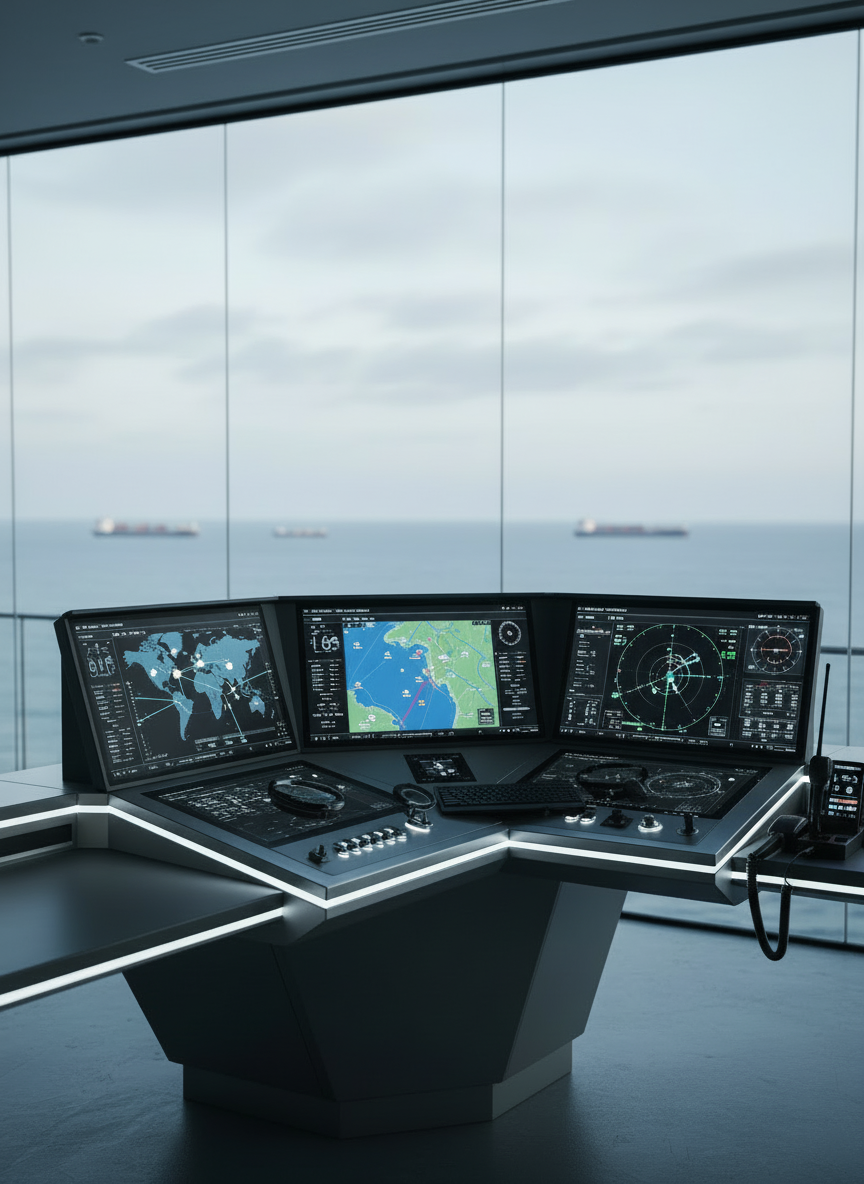
Every Singapore-flagged vessel operating in territorial waters or MPA-designated areas needs an AIS transponder — the Automatic Identification System that continuously broadcasts vessel identity, position, course and speed. The question is which one: Class A (mandatory for large commercial ships) or Class B (used by smaller commercial and pleasure vessels). This guide covers what MPA requires by vessel type, cost comparison, and which model to install.
What AIS actually does
AIS transponders broadcast on VHF marine radio channels 87B and 88B (161.975 and 162.025 MHz) at pre-defined intervals. Nearby vessels, MPA VTS Sub-Centres, and coastal stations receive these transmissions and display the vessel on their radar/ECDIS. In turn, your vessel receives all other AIS transmissions in range, showing you the collision picture.
AIS complements radar — it identifies vessels (by name and MMSI), gives more accurate position than radar returns, and tracks even small craft that don’t show well on radar.
Class A vs Class B — the real differences
| Attribute | Class A | Class B |
|---|---|---|
| Transmit power | 12.5 W | 2 W (Class B SO up to 5 W) |
| Position report interval | 2–10 seconds (speed dependent) | 30 seconds (Class B CS) / 5–15 seconds (Class B SO) |
| Access method | SOTDMA (self-organising) | CSTDMA (carrier-sense) / SOTDMA |
| Range typical | 20–40 NM | 5–15 NM |
| Data fields | Full — voyage, destination, ETA, draft, cargo | Static only (name, MMSI, dimensions) |
| Cost (SGD) | 2,200–3,800 | 700–1,500 |
| MPA-mandatory for | SOLAS vessels >300 GT, all passenger, tankers | Non-SOLAS commercial, pleasure craft in busy areas |
MPA requirements by vessel type
SOLAS vessels (>300 GT ocean-going, all passenger ships, all tankers): Class A mandatory. This is a SOLAS requirement carried into MPA rules.
Non-SOLAS commercial vessels (harbour craft, launches, pilot boats, tugs, workboats): MPA requires Class A or Class B depending on size and area of operation. Most Singapore harbour craft operators install Class B for cost; some install Class A for higher visibility in the port.
Fishing vessels: Class B typically sufficient for SG-flagged fishing vessels. Class A required for larger licensed vessels.
Pleasure craft (yachts, sailboats): Class B is standard. Some higher-end yachts install Class A for offshore passage-making.
Class B CS vs Class B SO — the newer split
Class B has two sub-types under updated ITU standards:
Class B CS (Carrier Sense): The original Class B. Waits for a quiet moment before transmitting. Slower report rate (30 seconds).
Class B SO (Self Organising): Newer, uses the same SOTDMA protocol as Class A. Higher transmit power (up to 5W). Faster report rate (5–15 seconds). Closer to Class A performance at Class B cost.
If you’re specifying a Class B installation in 2026, ask specifically for Class B SO. The extra ~SGD 100–200 versus Class B CS is worth it for the improved reliability.
Unsure whether your vessel will pass its next radio survey?
Tell us your vessel type and trading area. We will list what you need, what you already have, and what is missing.
Install considerations
AIS antennas are dedicated VHF whip antennas — cannot share with the vessel’s regular VHF. Mount as high as practical for line-of-sight range. Cable length matters: use low-loss coax (RG-8 or better) for runs over 10m. Ground the antenna properly.
MMSI must be programmed by an approved installer. This is not user-configurable on Class A units; can be entered on Class B units but incorrect entry causes MPA compliance issues.
Class A units also require connection to a GPS source, gyrocompass or rate-of-turn indicator, and an ECDIS or Minimum Keyboard/Display for entry of voyage data.
Common inspection failures
- Wrong MMSI programmed — usually because vessel changed hands and old MMSI still installed
- Static data outdated — ship name changed, dimensions wrong
- No RoT/heading input on Class A — required for full-report compliance
- VHF antenna too close to other antennas causing interference
What Envisiondata supplies
We supply MPA-approved Class A units from Furuno, JRC, Kongsberg and Class B SO units from em-trak, Vesper and Digital Yacht. Installation with MMSI programming, VHF antenna, and MPA survey preparation included.
Related reading
- MPA Singapore Radio Compliance 2026
- Iridium GMDSS vs Inmarsat GMDSS
- Satellite comms for SE Asia fishing vessels
Get an AIS quote
Tell us your vessel type, LOA and area of operation — we will recommend the right AIS class and quote in SGD with install labour. Sales at Envisiondata Pte Ltd — sales@envisiondatasg.com — or WhatsApp Steve directly on +65 9088 4899.
How we can help
Compliance mistakes usually surface at the worst time: during a survey, a port state inspection or a charterer audit. We help owners get the equipment, licences and paperwork right before that happens.
- Free equipment and licence check for your vessel
- Supply of GMDSS, VHF, EPIRB, SART and AIS equipment
- Installation, programming and survey preparation
- Help with IMDA and MPA application steps
What happens when you contact us
- Short call or meeting — we listen to how your vessels operate.
- Vessel and route review — we check equipment, space, power, contracts and licensing.
- Clear recommendation — a written proposal and SGD quote, with options.
- Install and support — commissioning, testing and ongoing support.
Related: GMDSS sea areas explained
Book a free compliance check
There is no obligation. If your current set-up is already the right one, we will tell you.
About the author
Steve leads Envisiondata Pte Ltd in Singapore. He has more than 20 years in cables, telecom infrastructure and satellite communications across ASEAN. He designs and supports connectivity for tugs, OSVs, harbour craft and commercial fleets across the region.

Written by Steve
Steve has over 20 years of experience in cables, telecom infrastructure and satellite communications across ASEAN. He founded Envision Data to help Singapore and SE Asia vessel operators choose and run the right maritime connectivity, from Starlink and OneWeb to Iridium, Inmarsat and GMDSS.
Leave a Reply